
When people hear “Montessori Math,” they might picture bead chains, manipulatives, and children working independently on the floor, choosing Math works from the shelf when the mood strikes. Middle school math in a Montessori environment looks very different—and intentionally so.
Adolescence represents a profound shift in human development, and Montessori education honors that shift by redesigning not just what students learn, but how and why they learn it. Middle school math, in particular, becomes a powerful tool for building reasoning, collaboration, confidence, and real-world competence.
Dr. Maria Montessori was clear: adolescence is not simply “older childhood.” It is its own developmental stage, defined by social growth, identity formation, and the need to understand one’s role in society. Where childhood is about developing independence, adolescence is about developing interdependence—learning how to function as an individual within a larger social world.
This developmental reality changes everything, including math instruction. A middle school Montessori classroom is not an upper-elementary work cycle with harder problems. It is a carefully structured environment that balances independence with responsibility, freedom with boundaries, and exploration with guidance.
Four Lenses for Montessori Middle School Math
In practice, our middle school math is viewed through four complementary lenses.
1. Math Workshop: Direct Instruction with Purpose
Math Workshop is a scheduled class that meets several times a week. Students are expected to attend and engage—an important support at a stage when time management and executive functioning are still developing. This structure also helps prepare students for the demands of high school.
Each workshop typically includes:
- A Problem of the Day to warm up thinking and encourage collaboration
- A focused lesson led by the guide
- Independent and small-group work on follow-up practice and projects, with opportunities for individualized support.
The goal is clarity, confidence, and conceptual understanding—not rushing through content.
2. Math Seminar: Critical Thinking & Communication
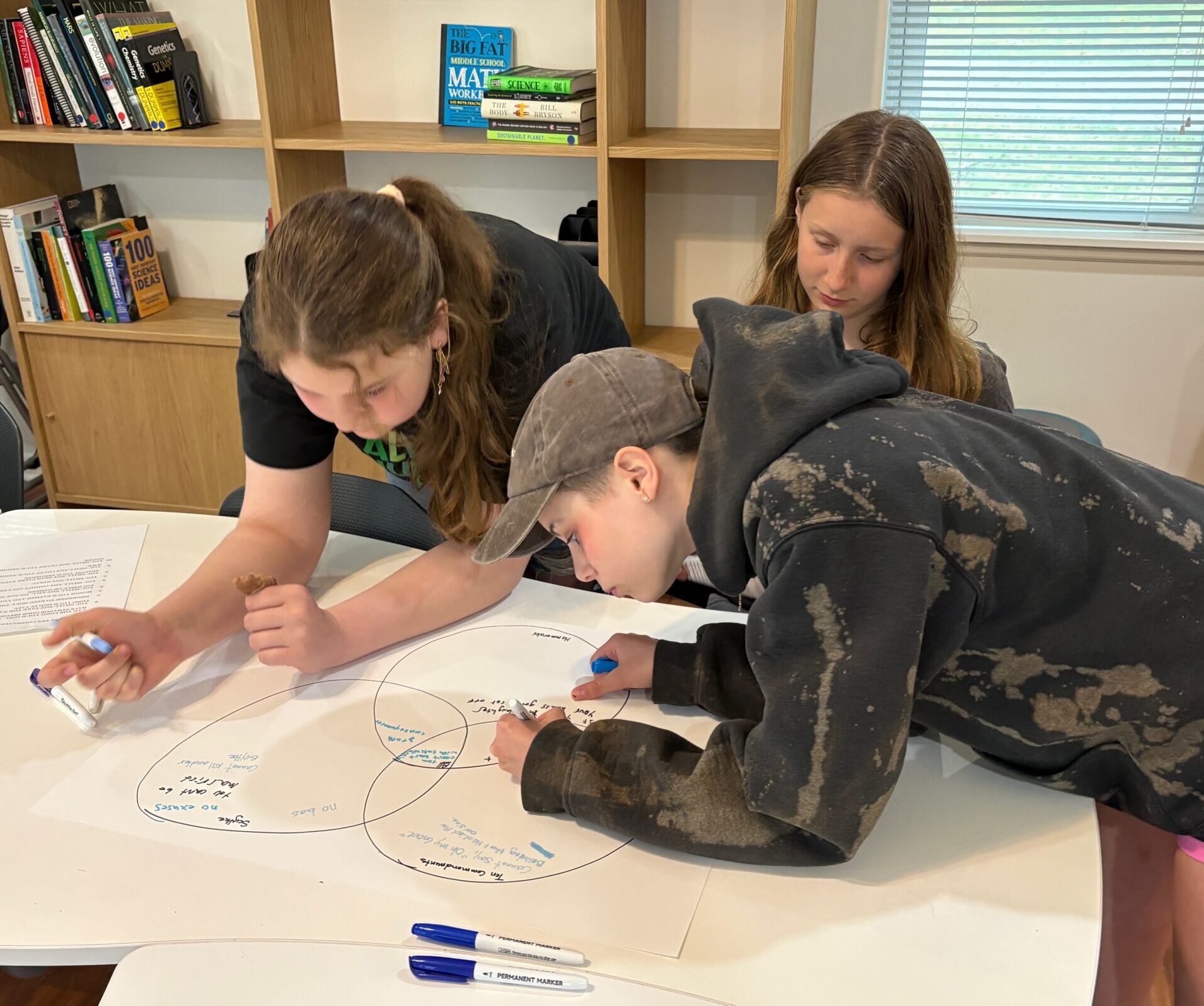
Weekly Math Seminar shifts the focus from answers to process. Students are given complex, often open-ended problems and time to think deeply before coming together to discuss.
In seminar, students:
- Share different problem-solving strategies
- Explain their thinking out loud
- Critique reasoning respectfully
- Learn the language of mathematics
This approach reflects current neuroscience. Understanding grows when students use multiple representations, think visually, and encounter diverse ways of solving the same problem. Even unsuccessful attempts are valuable, because they build insight and resilience.
3. Math Projects: “When Will I Ever Use This?”
This is where math becomes tangible. Projects bring math into the real world through hands-on, meaningful applications—designing, modeling, budgeting, analyzing data, or solving authentic problems. These experiences answer the age-old adolescent question not with words, but with action. Students don’t just practice math; they use it to help them accomplish a real-world task.
4. Math Beyond Math: Integration Across the Curriculum
Math doesn’t live only in math class. Students regularly apply mathematical thinking in interdisciplinary projects—running a business (the Microeconomy), analyzing scientific data, planning initiatives, or building models tied to larger thematic studies. Math becomes a practical tool for understanding the world, not an isolated subject.
The Bigger Picture
Montessori middle school math is not about producing faster calculators or perfect test-takers who can race through all the levels of Math. It’s about developing capable, confident thinkers who can use mathematics to understand—and shape—the world around them. Math becomes a tool for reasoning, communication, collaboration, and engagement with society. And that, ultimately, is very much in the spirit of Montessori education.
Adam Ladd, Adolescent Program Director